Main Oil Pump & Auxiliary Oil Pump — Cameron TURBO-AIR / IHI-Sullair Lubrication System Working Principle
Inside the lube oil system of Cameron TURBO-AIR (TA2000–TA11000) and IHI-Sullair centrifugal compressors: why the main pump must be vented before start-up, how the auxiliary pump stands by as backup, what the Y and Z piping does, and why the old both-rotational pump system was abandoned.
By Evan Chen, Technical Sales Manager, Turbomax · Published 25 October 2026 · Last updated 26 November 2026
Need any of these parts quoted? Send the part number — quotation within 24 hours.
OEM-equivalent dimensions · material certificates on request · worldwide shipping
We reply within 24 hours on working days. Send the part number, or a photo of the nameplate if you are unsure.
1. Main oil pump — acceleration is the enemy
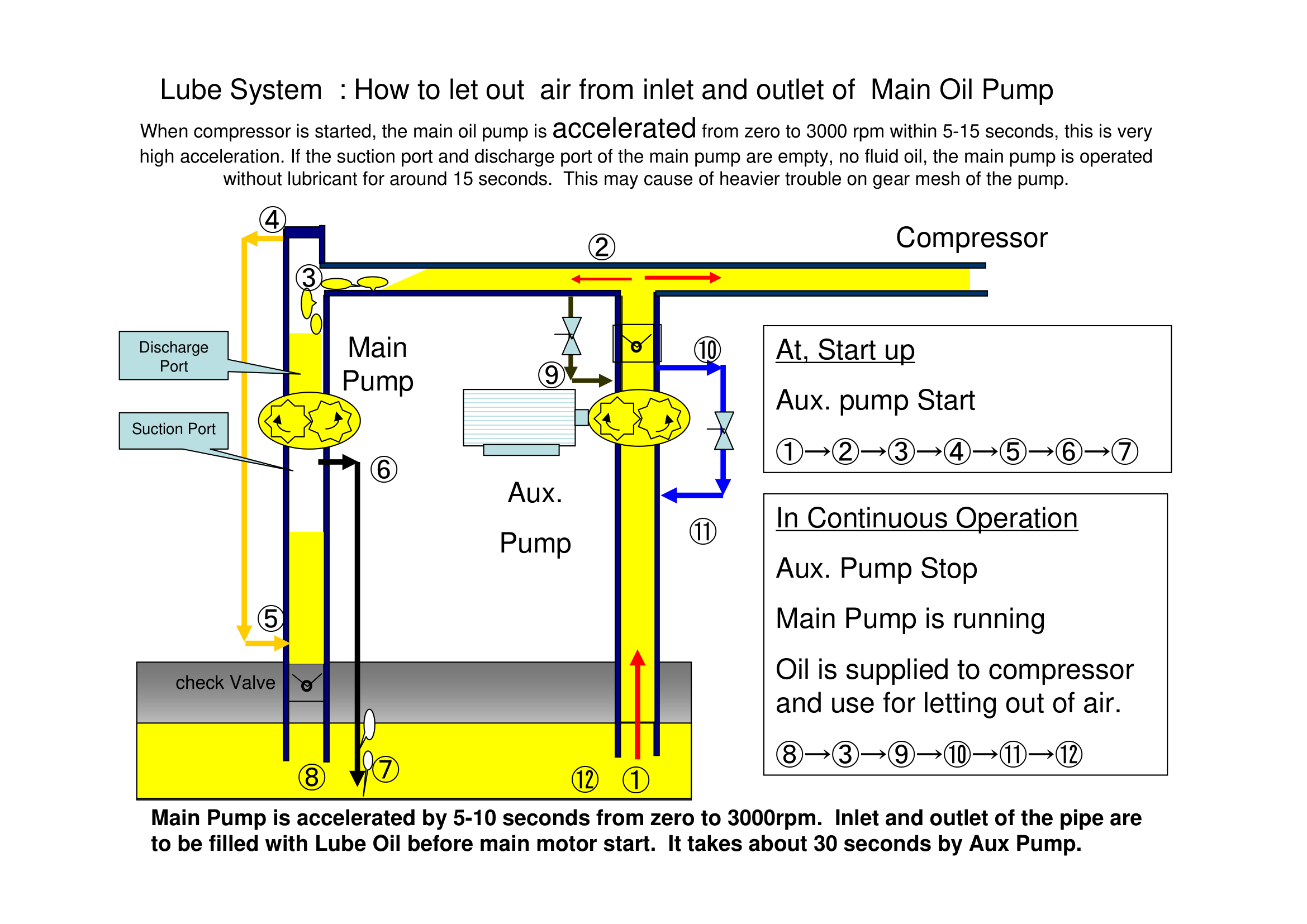
The main oil pump is the heart of the lube system. It is driven directly off the compressor rotor or bull gear, so its speed tracks the machine speed — from zero at standstill up to the full compressor operating speed. On a typical Cameron TURBO-AIR or IHI-Sullair turbo compressor, the main pump accelerates from zero to 3,000 RPM in only 5–15 seconds.
This is extremely high acceleration. If the suction port and discharge port of the main pump are empty — no liquid lubricant, only air — the pump runs dry for up to 15 seconds before oil finally arrives. A gear pump without lubrication scores the gear faces rapidly. On a compressor that costs tens of thousands of dollars to overhaul, a $500 pump can be the first thing to fail if air venting is skipped.
The rule: inlet and outlet of the main pump piping must be filled with lube oil before the main motor starts. The auxiliary oil pump does this job — it takes roughly 30 seconds to purge air from the main pump circuit and fully prime the system.
2. Auxiliary oil pump — standby backup, not a second main pump
Unlike the main pump, the auxiliary pump (also called the standby or emergency pump) is electrically driven — it does not depend on compressor rotation. It serves two roles:
- Start-up priming — fills the main pump and piping with oil before the motor starts
- Backup lubrication — auto-starts if system oil pressure drops below the trip setpoint, typically 0.1 MPa, and delivers lubrication until the main pump can take over or the machine is safely shut down
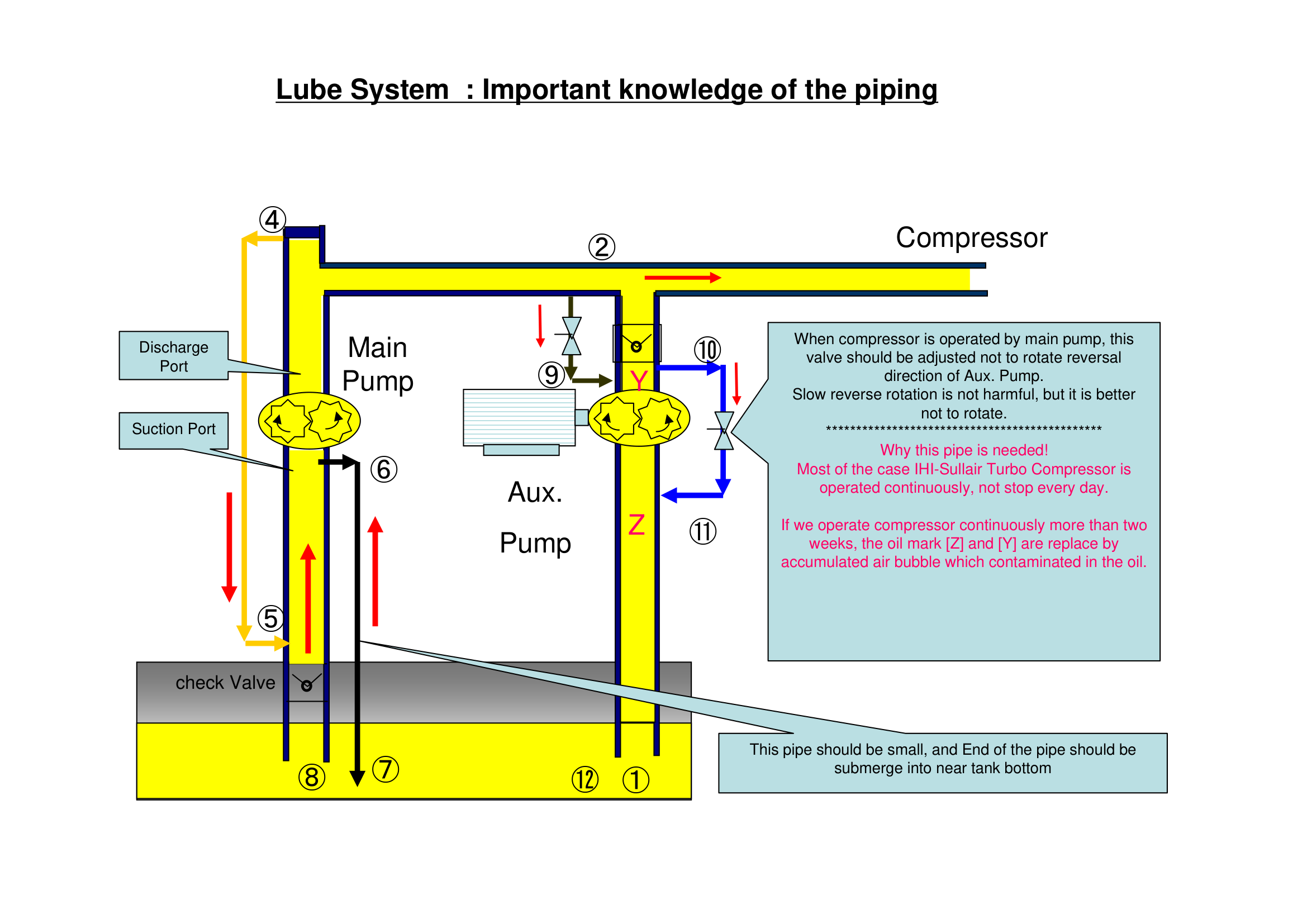
During normal steady-state operation the auxiliary pump is stopped. The check valve between the main and aux pump discharge lines prevents main-pump oil from flowing backwards through the aux pump — though slow reverse rotation of the aux pump is not harmful, it is best avoided for bearing life.
3. Why the Y and Z pipes are there — the air-bubble problem
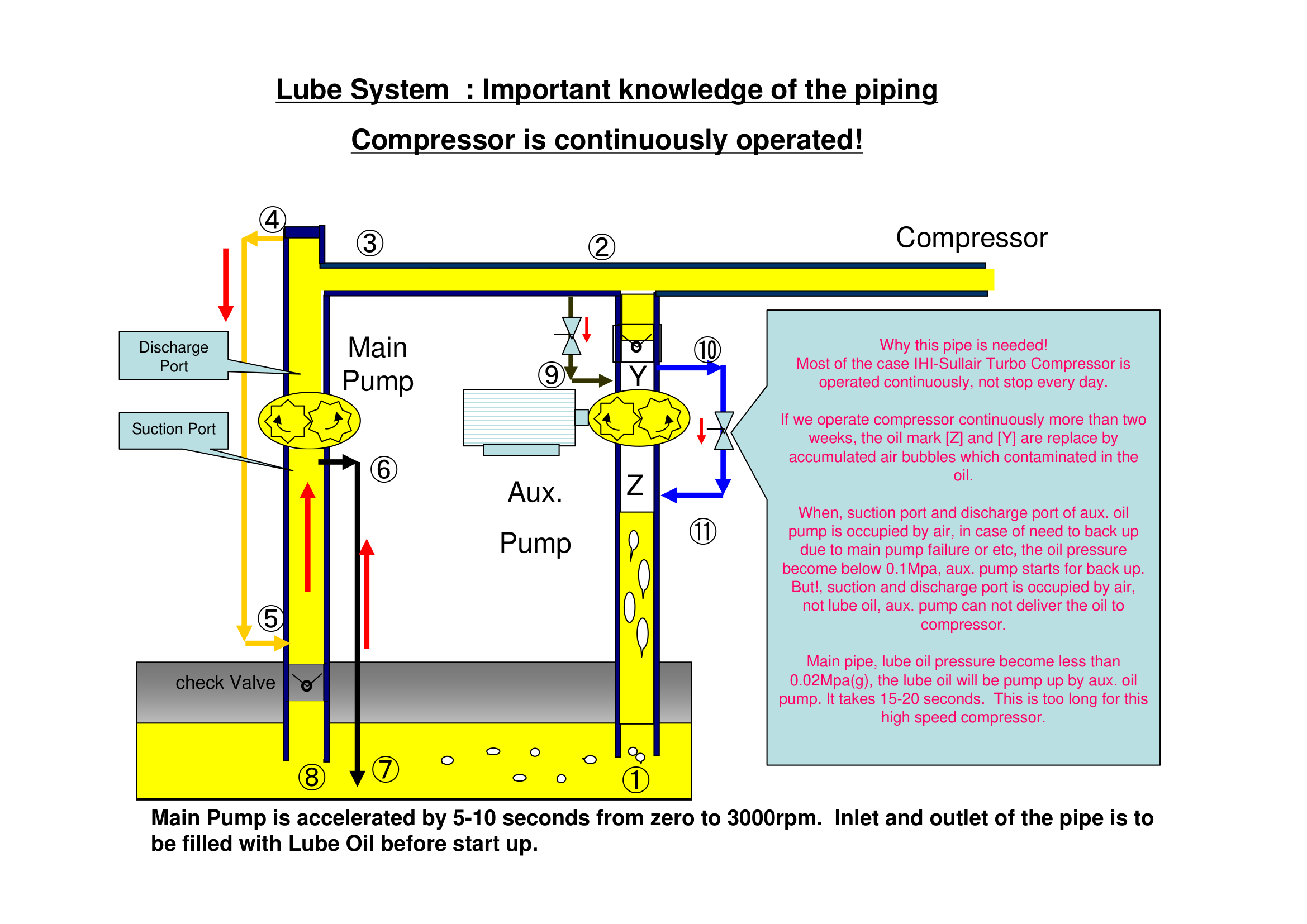
This is the most overlooked part of the lube system on Cameron and IHI-Sullair machines. Most turbo compressors run continuously — they do not stop every night. When a compressor operates for two weeks or more without shutdown, tiny air bubbles that are always dissolved in the lube oil gradually come out of solution. They rise and collect at the high points of the aux pump piping, specifically at the two positions labelled [Z] on the suction side and [Y] on the discharge side of the aux pump.
This is dangerous. Here is what happens when the aux pump is needed:
- Main pump develops a fault — or the pressure from the main pump circuit drops for any reason
- System oil pressure falls below the auto-start setpoint (0.1 MPa), and the aux pump starts
- But the aux pump's suction and discharge ports are occupied by air, not liquid oil
- The aux pump cannot deliver lubrication to the compressor bearings
- System pressure continues to drop until it reaches roughly 0.02 MPa(g), and only then can the aux pump finally push oil through the circuit — a delay of 15–20 seconds
For a high-speed turbo compressor running at 3,000 RPM or more, 15–20 seconds without lubrication is an emergency. Bearings can wipe, gears can score, and the machine can seize.
The Y and Z pipes are the solution. Their job:
- Y pipe — connects main pump discharge to aux pump discharge. When the compressor runs on the main pump, oil flows through the Y pipe and prevents the aux pump from being driven backwards by the pressure differential. Slow reverse rotation is not harmful, but better avoided.
- Z pipe — small-diameter line connecting the aux pump suction side back into the oil tank. The end of the Z pipe must be submerged near the bottom of the tank, where it continuously sweeps accumulated air bubbles back into the tank atmosphere. This keeps the aux pump circuit full of ready-to-use oil whenever it is needed.
4. Why the old both-rotational pump system failed
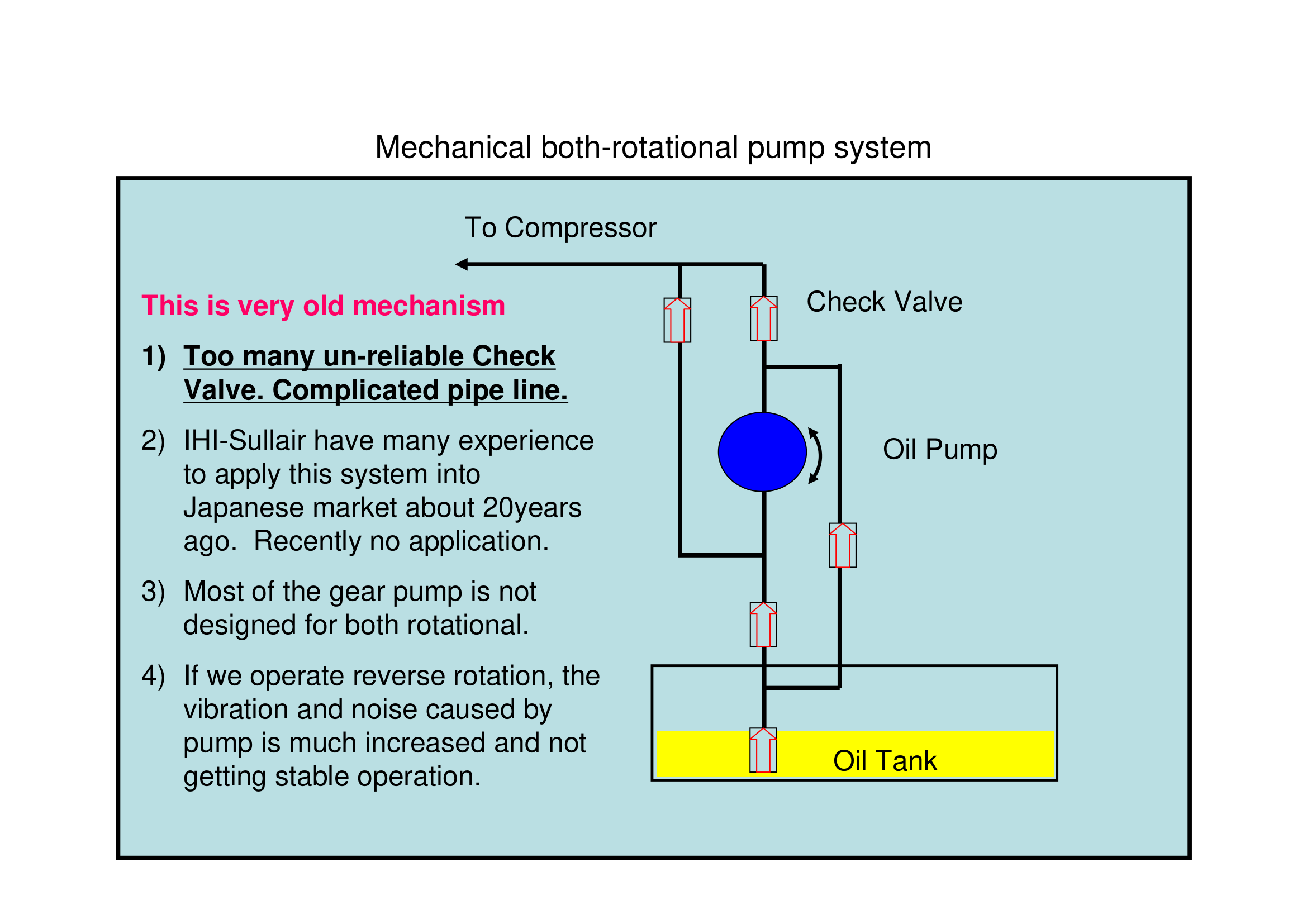
If you work on older Cameron TURBO-AIR or IHI-Sullair machines, you may encounter a completely different lube oil system: a single gear pump designed to rotate in both directions, combined with multiple check valves. The idea was clever — one pump could serve as main or aux depending on rotation direction, eliminating the need for a second pump entirely. IHI-Sullair applied this system to some Japanese-market compressors about 20 years ago.
They abandoned it for four reasons:
- Too many unreliable check valves made the circuit complex and difficult to maintain in the field
- Most gear pumps are not designed for bidirectional rotation, which reduces gear and bearing life
- Reverse rotation produced significantly higher vibration and noise, and the machine never settled into stable operation
- After accumulating field data on both systems, the dual-pump (main + aux) configuration was clearly more reliable
Turbomax supplies drop-in replacement oil pumps and pump gears, check valves, complete lube oil piping kits, auxiliary pump motors, pressure switches, and lube oil coolers for the full Cameron TURBO-AIR series (TA2000, TA3000, TA6000, TA9000, TA11000, MSG) and IHI T2A/T3A/TRA/TRE/TRX/TXA. We also overhaul pumps and flush lube systems on-site.
→ Browse all Cameron parts · Browse all key components
Frequently asked questions
Why does the main oil pump need air venting before start-up?
The main pump accelerates from zero to 3,000 RPM in 5–15 seconds. If the pump ports are empty, it runs dry for up to 15 seconds — scoring or seizing the gears. The aux pump primes the circuit approximately 30 seconds before start.
How does the aux pump know when to start?
An oil-pressure switch set to approximately 0.1 MPa(g) auto-engages the aux pump when system pressure drops. The aux pump stops when pressure recovers to about 0.2 MPa(g).
What causes air bubbles to accumulate in the aux pump circuit?
Two or more weeks of continuous compressor operation without shutdown. Air always dissolved in the lube oil gradually comes out of solution and rises to the high points of the aux piping at [Z] and [Y].
What pressure setpoint should the aux pump trip at?
Setpoints vary slightly by machine frame. Typical values: aux pump starts at 0.10–0.15 MPa(g), stops at 0.20–0.25 MPa(g). Always verify against your OEM specification sheet.
Who supplies Cameron oil pumps and lube system spare parts?
Turbomax manufactures and supplies replacement oil pumps, pump gears, check valves, piping kits, aux pump motors, pressure switches and lube coolers for all Cameron TURBO-AIR and IHI-Sullair centrifugal compressors. Contact us via WhatsApp +86 13814834140 or email turbomax@126.com with your compressor serial number or OEM part number.
Need a pump or lube system quotation?
Send us the pump OEM part number, a photo of the lube system piping diagram, or a photo of the old pump housing. We will confirm the correct fitment for your compressor frame, quote it, and tell you whether a complete lube-oil flush and Y/Z piping inspection should be scheduled alongside the pump change.