Cameron TA11000 Overhaul — On-Site Photo Record
A Cameron TA11000 integrally geared compressor opened on its own foundation: the package lifted and stripped, stage casings opened, and the impeller, diffuser, inlet scroll, pinion shaft, bull gear, thrust bearing, intercooler and aftercooler inspected and serviced by the Turbomax team, with the replacement pinion shaft and rotor assembly supplied from our Suzhou workshop.
By Evan Chen, Technical Sales Manager, Turbomax · Published 17 November 2026 · Last updated 26 November 2026
Key points from this TA11000 overhaul
- This was an on-site overhaul: the package stayed on its foundation and only the replacement pinion shaft was manufactured, measured and balanced in the Suzhou workshop.
- Impeller and diffuser were read as one pair on every opened stage, because the impeller adds velocity and the diffuser recovers it as pressure — measuring only one gives a misleading diagnosis.
- Rub marks at the impeller eye point to axial position — the thrust bearing or the pinion shaft stack-up — not to the impeller itself.
- The new pinion shaft was supplied as a rotor assembled and dynamically balanced in two planes, with the residual unbalance on a report, which removes the most error-prone step from site work.
- The intercooler and aftercooler water side was opened instead of being judged from the control panel, and a spare bundle can be built and pressure-tested before the outage.
Planning a TA11000 overhaul or need parts? Send the model and serial number — quotation within 24 hours.
Impeller · pinion shaft · rotor assembly · coolers · bearings · drawings and certificates on request
We reply within 24 hours on working days. Send the part number, or a photo of the nameplate if you are unsure.
Quick facts
| Item | Detail |
|---|---|
| Machine | Cameron TURBO-AIR TA11000 integrally geared, oil-free centrifugal air compressor, packaged on one skid |
| Work type | On-site overhaul: strip-down, inspection, cleaning and reassembly on the machine foundation |
| Air end | Stage casings and inlet scrolls opened; impeller, diffuser and volute inspected on every opened stage |
| Rotor train | Bull gear and pinion shaft mesh checked, journal and thrust bearing condition assessed, clearances recorded |
| Coolers | Intercooler and aftercooler water side opened, tube plates and gaskets inspected, cooling water connections checked |
| Parts supply | Replacement pinion shaft and rotor assembly, bearings, seals, gaskets and cooler parts supplied by Turbomax |
| Performed by | Turbomax service team, with parts manufactured and inspected in Suzhou |
Machine background
The TA11000 is one of the larger frames in the Cameron TURBO-AIR TA family. A single bull gear in the gearbox drives several high-speed pinion shafts, and each pinion shaft carries an impeller at its overhung end. Air enters a stage through the inlet scroll, is accelerated by the impeller, slowed and recovered as pressure in the diffuser, and then crosses the intercooler before the next stage; the last stage discharges through the aftercooler. Journal bearings support each pinion shaft radially, while a thrust bearing fixes its axial position against the aerodynamic thrust of the impeller.
That architecture explains why a TA11000 overhaul is a system job rather than a single-part repair. Stage efficiency depends on the impeller, the diffuser and the inlet scroll acting together; discharge temperature depends on the intercooler and aftercooler; and the clearances that keep the impeller from rubbing depend on the pinion shaft, its bearings and the thrust bearing. Opening only one of these and leaving the rest untouched is the most common reason a machine comes back from an overhaul with the same high temperature, high vibration or low flow it went in with.
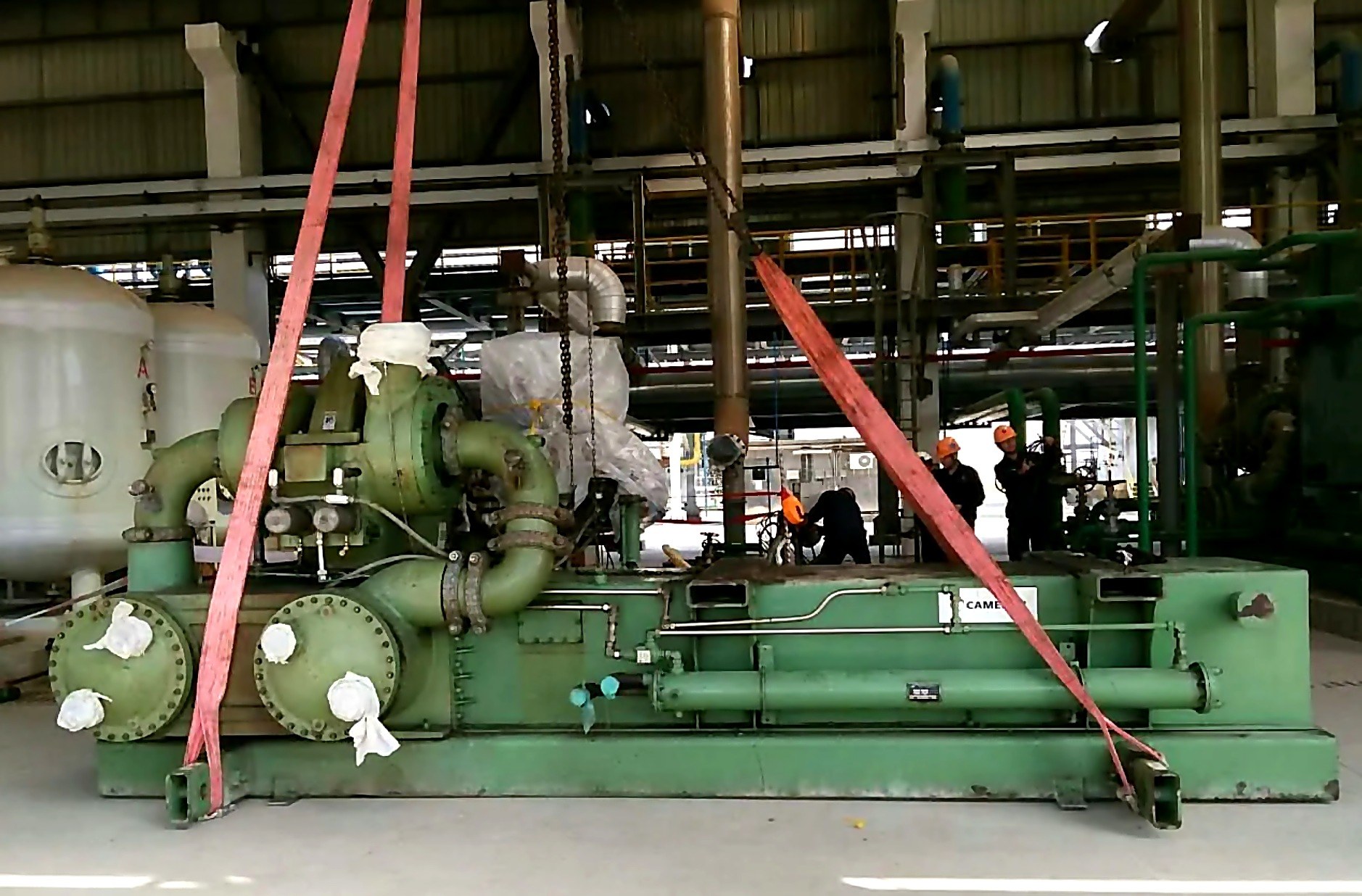
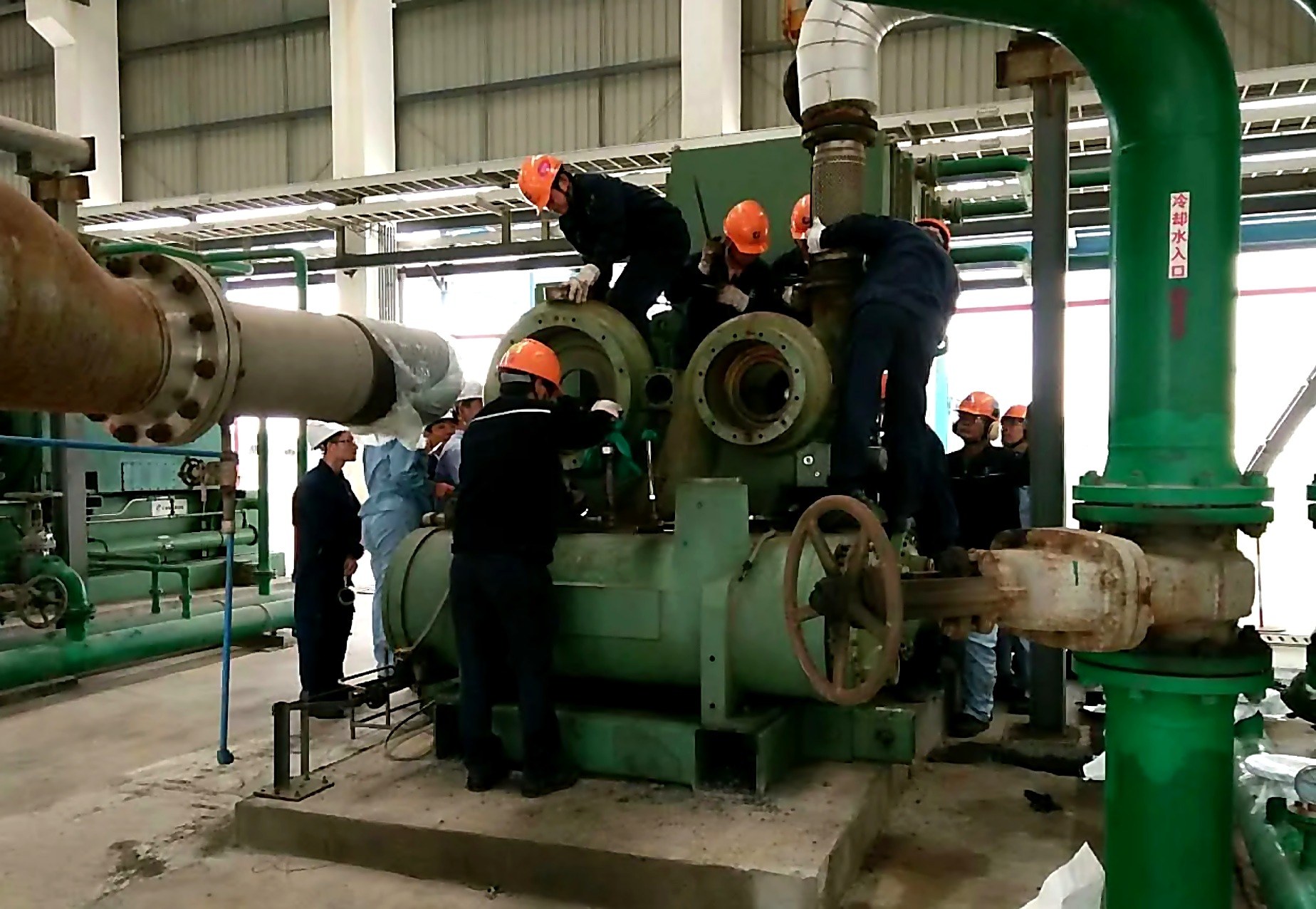
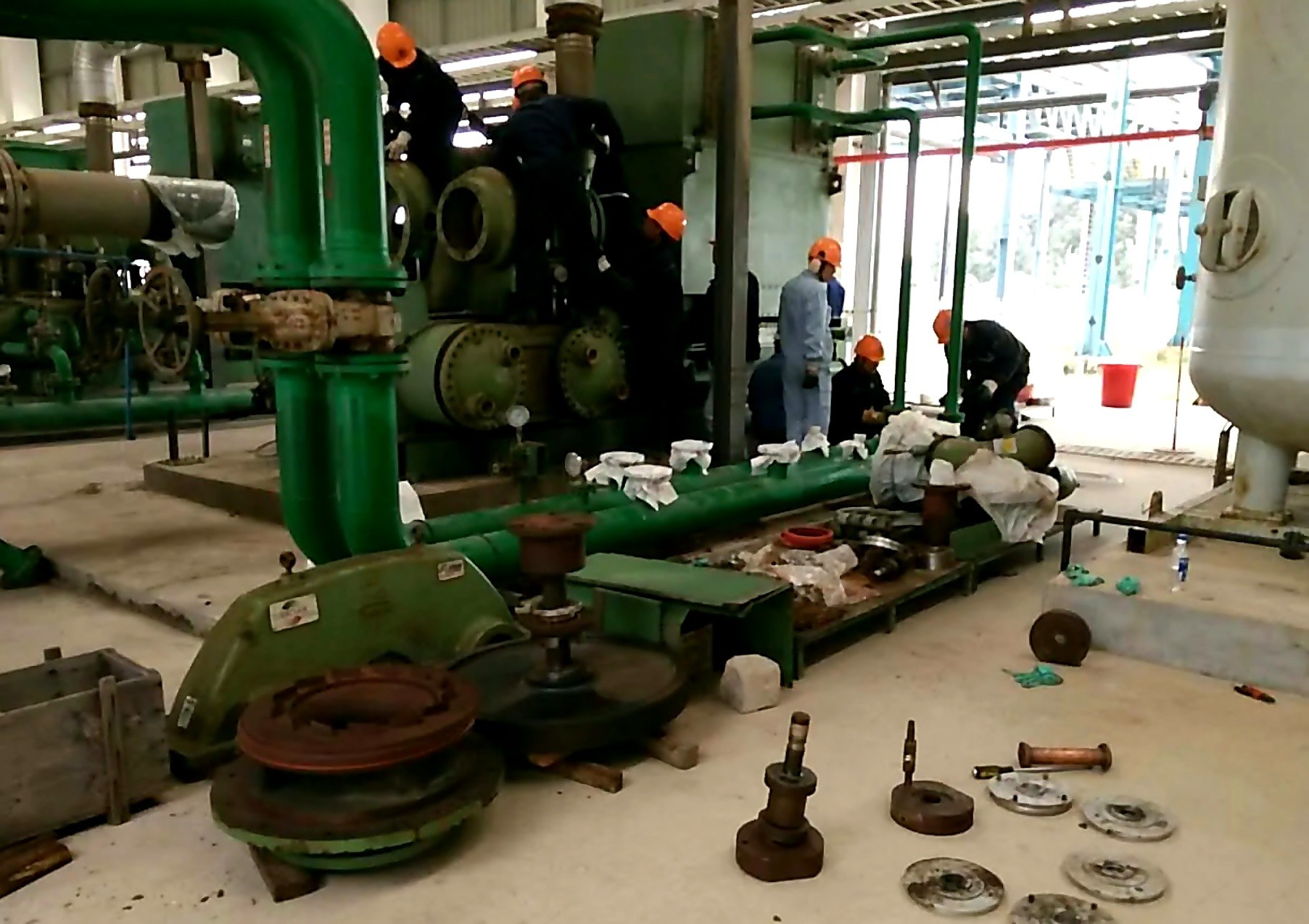
This machine was serviced on site. The photos below show the package rigged for lifting, the stage casings opened with the crew working on the machine, and the removed components laid out in sequence beside the skid. On-site work keeps the machine on its foundation and avoids a transport delay, but it only works if the measurement discipline is the same as in a workshop: every clearance written down, every part identified, and every replaced component traceable to a drawing.
Scope of work
- Rigging and package strip-down — lifting straps and a chain hoist were rigged over the casing, pipework and instruments were disconnected and labelled, and the mounting faces were cleaned before any cover was lifted.
- Stage casings and inlet scrolls opened — volute covers and inlet scrolls were lifted off so the impeller eye, the inlet passage and the diffuser of each opened stage could be inspected directly.
- Impeller and diffuser inspection — leading edges, blade tips, impeller nut locking and deposits were checked on the impeller, and the diffuser passages were checked for erosion, fouling and previous repairs.
- Rotor train, bull gear and pinion shaft — the gearbox was opened to inspect the bull gear and pinion mesh, journal condition and shaft journals; worn components were recorded for replacement, including a new pinion shaft supplied as a rotor assembled and balanced.
- Journal and thrust bearing checks — bearing surfaces, pad condition and clearances were measured, with the thrust bearing clearance recorded because it sets the axial position of the impeller.
- Intercooler and aftercooler service — cooler covers were removed, tube plates, water channels and pass partitions were inspected, gaskets were renewed and the cooling water inlet and outlet connections were checked.
- Reassembly with recorded clearances — impeller-to-inlet, diffuser and bearing clearances were recorded before the casings were closed, and the removed parts were laid out in sequence so that nothing was refitted in the wrong stage.
Photo record from the site
Reading the impeller and the diffuser together
On an integrally geared stage the impeller and the diffuser are one thermodynamic pair. The impeller adds velocity; the diffuser converts that velocity into pressure. If the impeller leading edges are eroded or the blade tips are thinned, the stage loses head. If the diffuser channels are fouled or eroded, the pressure recovery drops even with a perfect impeller. Measuring only one of the two gives a misleading diagnosis, which is why both were inspected on every opened stage of this TA11000.
Deposits tell their own story. A uniform grey film on the impeller usually means airborne dust passing the inlet filter; oily deposits point to oil carry-over from a seal or from the vent system; localised rub marks at the impeller eye point to an axial position problem rather than to the impeller itself. In that last case the cause is normally upstream in the thrust bearing or in the pinion shaft stack-up, and replacing the impeller alone would return the machine to the same rub within weeks.
Pinion shaft, bull gear and the rotor assembled
The bull gear runs at motor speed and drives each pinion shaft through a helical mesh. Mesh contact pattern, pitting and scuffing on the bull gear and on the pinion teeth are inspected together, because a damaged tooth on either member will damage its partner after reassembly. On the pinion shaft itself the journals are checked for scoring and for size, since the journal-to-bearing clearance decides both the oil film and the shaft orbit at speed.
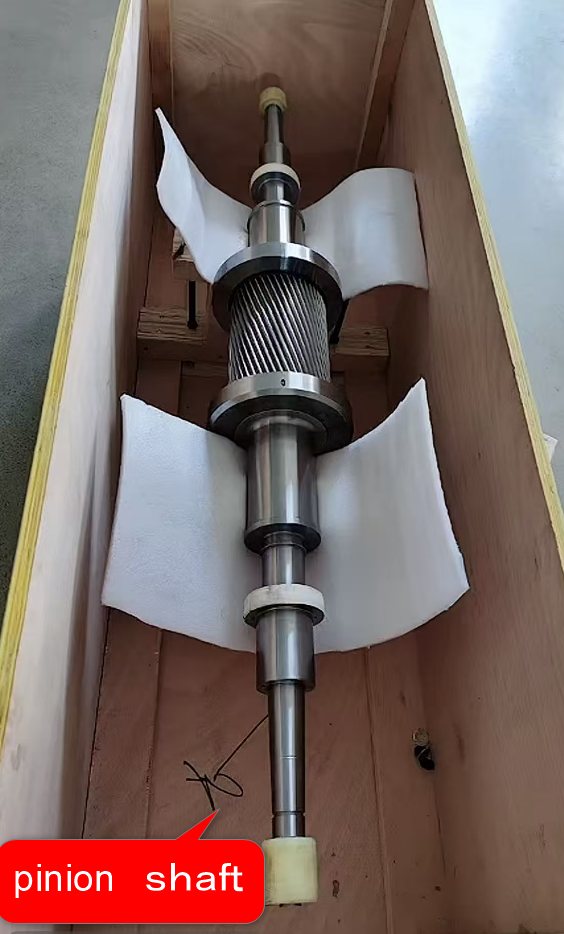
Where a pinion shaft is replaced, fitting the impeller to it is not a simple bolt-on. The impeller is mounted, locked and then the whole rotor assembled is dynamically balanced in two planes, with the residual unbalance recorded on a report. Supplying the rotor assembled and balanced, rather than a loose shaft and a loose impeller, removes the most error-prone step from the site work: the crew receives one recorded assembly, checks the clearances and closes the casing.
Why the thrust bearing decides the impeller clearance
Aerodynamic thrust pushes the impeller and its pinion shaft axially, and the thrust bearing is what resists that force. Its clearance therefore appears directly in the impeller-to-inlet scroll gap: too much axial float and the impeller can contact the inlet scroll under load changes; too little and the bearing runs hot. Measuring the thrust bearing clearance before closing the casing is a five-minute job that protects the most expensive parts in the machine, and it is recorded on this overhaul together with the radial bearing clearances.
Intercooler, aftercooler and the discharge temperature
The intercooler and aftercooler decide how much power the machine spends and how hot the delivered air is. A scaled tube bundle raises the approach temperature: the stage discharge creeps up, the driver current rises, and eventually the machine trips on high temperature. Because the cooling water inlet pipe and the cooler shells are accessible on this package, the water side was opened and inspected rather than guessed at from the control panel. Tube plates, water channels, pass partitions and gaskets were checked, and the gaskets were renewed on reassembly.
For plants planning a shutdown, this is also the moment to deal with spare coolers. A tube bundle can be manufactured and pressure-tested in advance, so the old bundle comes out and the new one goes in during the same outage instead of waiting for a repair while the machine is down.
Spare parts for this TA11000
Every component named in this case can be quoted individually or as an overhaul kit. Send the part number from your spare parts list, or a photo of the part with the machine model and stage number, and we cross-check the drawing before quoting. Standard wear parts are quoted against stock; engineered parts such as the impeller, diffuser, inlet scroll, pinion shaft, bull gear and cooler bundles are manufactured to order with dimensional reports.
Closed impellers for TA-series stages, machined to the original envelope, dynamically balanced with a report.
High-speed pinion shafts with helical gear, journals ground to size, supplied alone or as a rotor assembly.
Pinion shaft and impeller supplied as one balanced rotor assembly, ready to fit and recorded on a balancing report.
Tube bundles, tube plates, water covers and gaskets for the intercooler and aftercooler of TA-series machines.
Inlet scrolls and volute covers, with the bore that sets the impeller inlet clearance machined to drawing.
Diffusers and diffuser plates matched to the stage, restoring the designed pressure recovery and stage efficiency.
Bull gears and gear sets manufactured to the original tooth geometry, checked for mesh contact before dispatch.
Thrust bearings and tilting pad journal bearings that set the axial and radial position of the pinion shaft.
The full list of TA-series components is on the Cameron TA11000 spare parts page, and the same team carries out overhaul and rotor work for other Cameron and IHI frames.
On-site or workshop: how the choice changes the plan
Moving a TA11000 is a project on its own. The package has to be isolated from the air, water and power systems, rigged out of the compressor room, transported, reinstalled and realigned before a single clearance can be checked. For work that is inspection, clearance setting, bearing and seal renewal and cooler cleaning, that transport cycle adds cost and risk without adding anything the crew cannot do on the foundation.
The decision is not about size, it is about what the work actually is. On-site is the right call when the machine only needs to be opened, measured, cleaned and put back together. It is the wrong call when a casing or a gearbox component needs machining, when a new rotor has to be balanced, or when the foundation and the alignment are themselves in question. On this TA11000 the split was deliberate: strip-down, inspection and reassembly on site, while the replacement pinion shaft was manufactured, measured and balanced in the workshop and delivered as a finished part.
What makes on-site work succeed is not the crane, it is the measurement discipline. Every clearance is written down as it is taken, every removed component is tagged to its stage, and anything sent back to the workshop is identified by drawing number rather than by a photograph. Without that discipline the machine goes back together on judgement, and judgement is what the next overhaul has to correct.
Frequently asked questions
Can a Cameron TA11000 be overhauled on site, without moving the machine?
Yes, most of the work can be done on the foundation: volute covers, inlet scrolls, cooler covers and the gearbox cover are lifted with the plant crane or a chain hoist, and the rotor train, diffusers, bearings and seals are serviced beside the machine. Machining, dynamic balancing and impeller or pinion shaft replacement are done in our workshop in parallel, so the site crew is never waiting on a part.
Which TA11000 spare parts are usually needed for an overhaul?
Bearings including the thrust bearing, seals and O-rings, casing and cooler gaskets and oil filter elements form the basic kit. Wear-dependent items are the impeller, diffuser, inlet scroll, pinion shaft or a rotor assembled and balanced, the bull gear, and intercooler or aftercooler tube bundles. We quote against your part numbers or photos.
What does the thrust bearing have to do with impeller clearance?
The thrust bearing fixes the axial position of the pinion shaft, and the impeller sits on that shaft. Excess thrust clearance lets the impeller move towards the inlet scroll or diffuser and changes the running clearance, which can lead to rubbing. Thrust clearance is therefore measured and recorded before the casing is closed.
How do I confirm that a cooler is causing high discharge temperature?
Compare stage discharge temperature with cooling water inlet temperature at constant load. A rising approach temperature indicates water-side fouling or damaged tubes. Opening the cooler covers, as on this TA11000, confirms the cause directly on the tube plates and water channels.
Do you supply a complete TA11000 rotor assembled and balanced?
Yes. The pinion shaft and impeller can be supplied as one rotor assembly, dynamically balanced with a report, together with dimensional inspection records and material certificates. Journals, gear teeth and shaft ends are protected in a wooden crate for shipping.
Can I share this case with my customer or maintenance team?
Yes. Use the WhatsApp, LinkedIn or email buttons above, or copy the link. The photos and inspection points help a maintenance planner scope a TA11000 shutdown and order parts before the outage.
Other maintenance cases
- Cameron TA9000 overhaul — volutes opened, gear mesh and pinion bearings, new rotor assembly
- Cameron TA6000 overhaul — rotor, impeller and dynamic balancing record
- Cameron TA2000 overhaul — impeller, inlet bell, cooler and control system
- Cameron MSG overhaul — integrally geared machine service