Why Do Centrifugal Compressor Impellers Fail?
Particle erosion, cavitation and fatigue cracks — explained from a real inspection where all three impellers of an IHI TRE100E at a shipyard were damaged at the same time: blades thinned from root to tip, 4 mm of leading edge gone, and cracks at the third-stage impeller root.
The impeller is the heart of a centrifugal compressor: every kilogram of air passes through it at several hundred metres per second. When an impeller wears, the machine quietly loses efficiency long before anyone opens the gearbox — and in the worst case a cracked impeller lets go at operating speed. Buyers and maintenance engineers often ask why centrifugal compressor impellers fail and how to catch the damage before it costs a shutdown. Below are the five failure modes we see most, followed by a documented case: an IHI TRE100E air compressor at a shipyard where all three stages were damaged at once.
The five most common impeller failure modes
- Solid particle erosion — dust and scale particles that pass through the inlet air filter strike the blades at near-sonic speed and sandblast the surface away, starting at the leading edge and the blade root.
- Cavitation and droplet impingement — condensed moisture and entrained particles locally remove material, so blades thin from root to tip and the leading edge eventually loses metal in chunks.
- Fatigue cracks — unsteady aerodynamic loads, vibration, surge events and frequent starts cycle the blade root thousands of times; cracks initiate at stress concentrations such as the blade root fillet.
- Fouling and corrosion — sticky dust and corrosive gases build up on the flow path, changing the blade profile, unbalancing the rotor and attacking the base material.
- Surge damage — each surge event reverses flow through the impeller and shock-loads the blades; repeated surges accelerate both erosion and cracking.
In practice the modes combine: eroded and cavitated blades change the flow pattern, the changed flow raises blade stresses, and a fatigue crack finishes the job. That is exactly what the next case shows.
Real case: all three impellers of an IHI TRE100E damaged at the same time
Our service team inspected the rotor of an IHI TRE100E (1,050 kW) oil-free centrifugal air compressor serving a shipyard in South China. The machine had been running with gradually falling performance, and the inspection confirmed why — every stage was damaged:
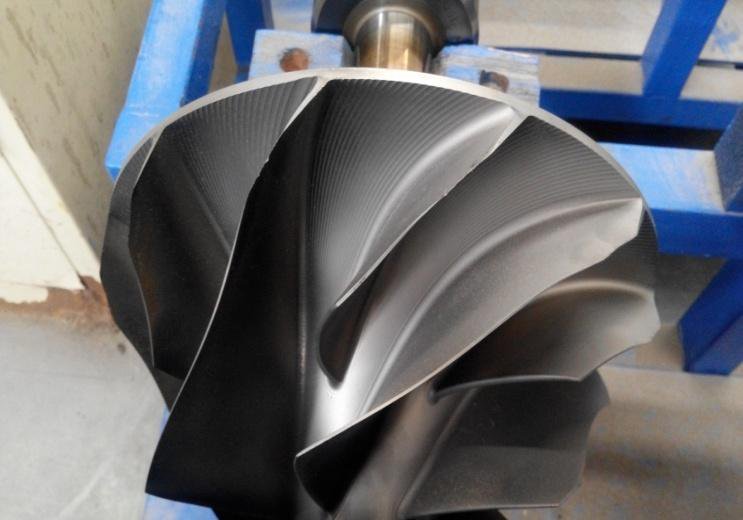
- 1st-stage impeller — every blade thinned from root to leading edge; about 4 mm of the blade edge missing, hitting stage efficiency and creating a real risk of blade failure.
- 2nd-stage impeller — severe cavitation at the blade roots with larger cavities, the same thinning towards the leading edge, and again about 4 mm of edge loss.
- 3rd-stage impeller — cracks at the impeller root, the most dangerous condition of all: at operating speed a cracked impeller does not degrade, it fails.
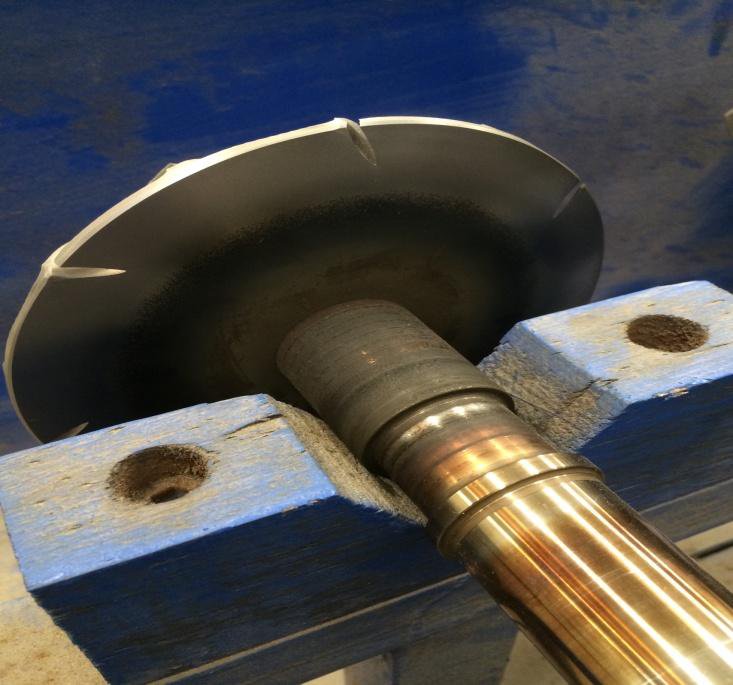
A healthy impeller, for comparison — uniform blade profile and clean machined surfaces:
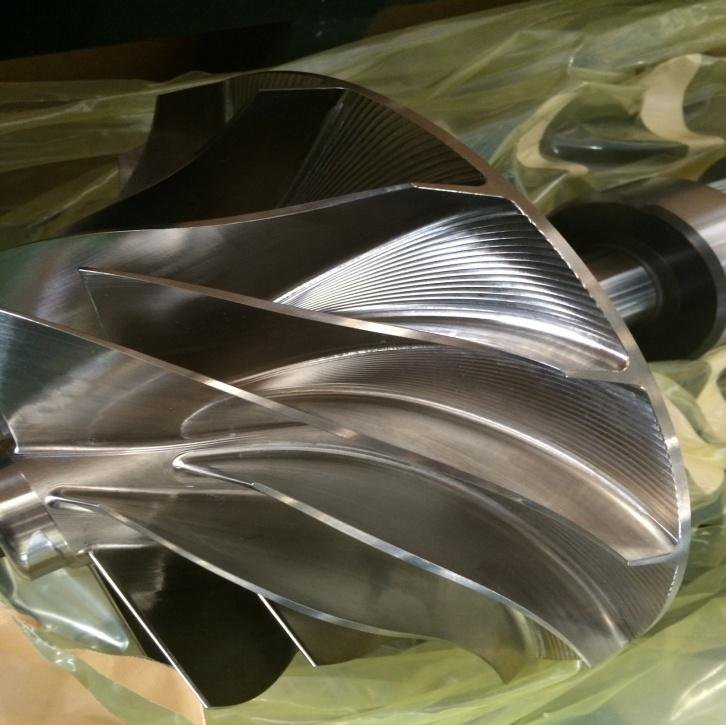
1st stage — blades thinned from root to tip, 4 mm of leading edge missing:
Leading-edge detail — material progressively eaten away:
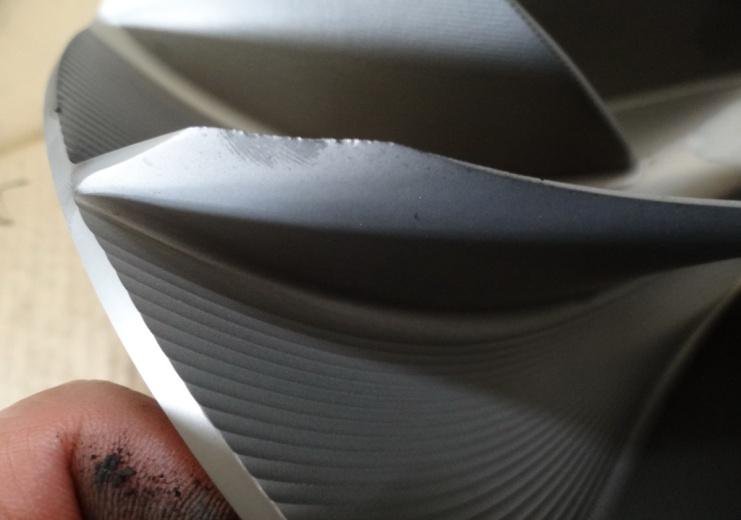
2nd stage — cavitation at the blade roots:
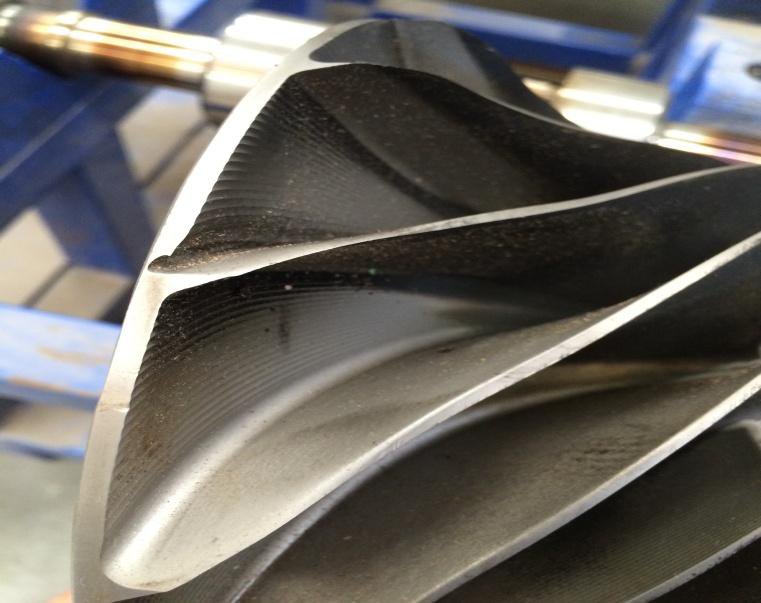
3rd stage — cracks at the impeller root:
The root cause was at the inlet — not inside the compressor
The damage pattern told the story: all blades thinning in the same way, cavitation growing stage by stage, cracks appearing first where the stresses are highest. The conclusion of the inspection report: the inlet air filter was not stopping larger airborne particles. A shipyard is one of the worst possible environments — welding fume, blasting dust and salt-laden coastal air — and every particle that gets through the filter becomes high-speed sand inside the compressor.
The corrective action was therefore two-sided: replace all three damaged impellers, and upgrade the intake with a self-cleaning (pulse-jet) panel air filter rated 99.999% at 0.5 µm, so the particles that erode and cavitate the blades never reach them again. Replacing impellers without fixing the filtration only resets the clock — the new set would wear out the same way.
Early warning signs of impeller damage
- Discharge pressure will no longer hold at full load — the classic symptom: the machine runs, but the pressure/flow point keeps sliding back.
- Power consumption creeping up for the same air output — efficiency lost to the changed blade profile.
- Changes in vibration or sound — uneven erosion unbalances the rotor; cracked blades change the blade-passing signature.
- Frequent surge or blow-off events — both a cause and an effect of impeller damage.
None of these symptoms tells you which stage is damaged — that takes opening the machine. At every major overhaul the impellers should be cleaned and given a dye penetrant (PT) inspection, the same check we apply to every impeller that comes through our workshop; see how it looks in a real job in our IHI TX-A second major overhaul case.
How to prevent impeller failure — 4 practical rules
- Filter the intake properly. Match the filter to the site: in dusty, coastal or shipyard environments use a high-efficiency self-cleaning filter (99.999% @ 0.5 µm class) and monitor the pressure differential.
- Keep moisture out of the flow path. Drain condensate traps, check cooler performance — water droplets are what drive cavitation on the blades.
- Stay out of surge. Keep the anti-surge valve and control loop working; log every surge event instead of shrugging it off.
- Inspect at every major overhaul. Clean, PT-check and record. Damage found at 4 mm is a parts order; damage found as a crack is an emergency.
Replacing damaged impellers — what to order
When an inspection condemns an impeller, the replacement route matters. Turbomax supplies new replacement impellers for IHI TRE, TRX, TXA, TRA and T2A compressors — manufactured to the original geometry, five-axis machined, dye-penetrant inspected and dynamically balanced as an assembly before delivery, so the rotor goes back into service with a verified balance grade. The same route covers Cameron, Atlas Copco ZH and Hanwha machines; see the range on our impeller page and the IHI model lists under TRE parts and TRX parts. If your machine is approaching its next major overhaul, our A–E service grade guide shows what to inspect and replace at each level.
FAQ
What causes cavitation on a centrifugal compressor impeller?
Dust-laden air and condensed moisture. Particles and droplets accelerated through the impeller passages strip material from the blade surface — first at the root and leading edge, until the blade thins visibly and the edge starts losing metal in chunks.
Can a damaged compressor impeller be repaired?
Light fouling: clean and re-coat. Minor edge damage: sometimes blend and re-balance. But blades with millimetre-scale material loss, root cavitation or visible cracks must be replaced — a cracked impeller can burst at operating speed, as in the TRE100E case where all three stages were condemned.
How often should impellers be inspected?
At every major overhaul per the maker's A–E service grades — typically around 20,000–35,000 running hours — with cleaning and dye penetrant inspection. Between overhauls, track discharge pressure, power draw and vibration.
What inlet filter best protects the impellers?
A high-efficiency self-cleaning (pulse-jet) filter. The TRE100E root cause was inadequate filtration; the fix was a self-cleaning unit rated 99.999% at 0.5 µm. A filter is far cheaper than three new impellers and one unplanned shutdown.
Spare parts by model
T2ATXATRATRET3ATRXTA3000TA6000TA9000TA11000MSG
Related reading: Impeller, diffuser and scroll — how a stage works · A–E service grades and overhaul planning · IHI TX-A overhaul with impeller PT inspection