Cameron TA3000 Intercooler & Aftercooler — Design, Location and Replacement Guide
The Cameron TA3000 (marketed originally as the Cooper Turbo Air 3000) is a three-stage integrally geared centrifugal compressor rated 400–800 hp / 300–600 kW, delivering 1,800–4,000 cfm at up to 150 psig. Because it compresses in three stages, it carries three separate heat exchangers: a first-stage intercooler, a second-stage intercooler and a final aftercooler. This guide covers where each cooler sits in the train, what the OEM parts diagram actually tells you, and how to judge when a TA3000 intercooler or aftercooler has reached the end of its service life.
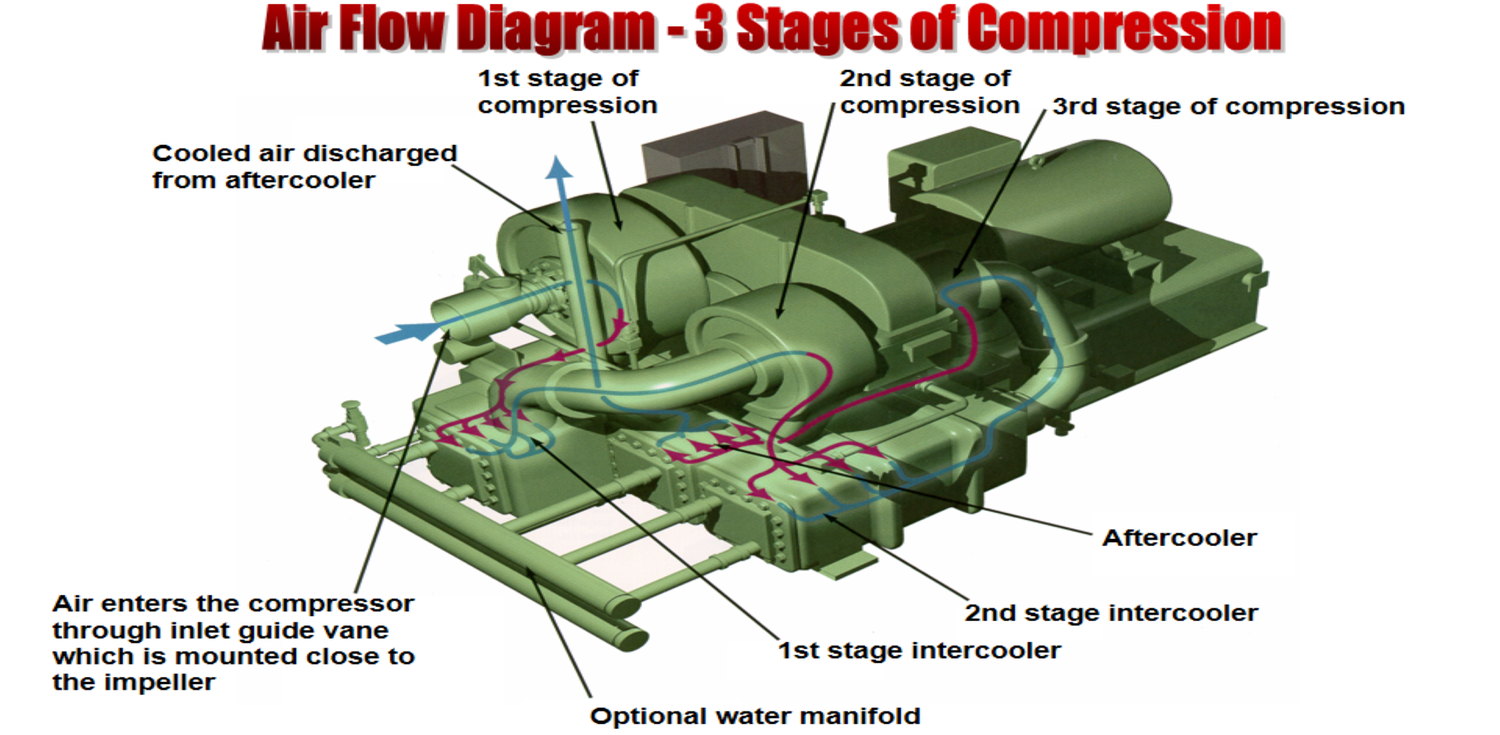
Three stages of compression, three heat exchangers
Compression heat is the unavoidable by-product of raising air pressure. In a single-stage machine all of that heat has to be removed at one point; in the TA3000 the work is split across three impellers on a common horizontal gear box, and a cooler is placed after each compression step except the last. Air enters through the inlet guide vane mounted close to the first-stage impeller, is compressed, then passes through the first-stage intercooler before entering the second impeller. The cycle repeats at the second-stage intercooler, and the third-stage discharge is finally cooled by the aftercooler before leaving the package.
Intercooling between stages is not optional housekeeping — it is what makes a three-stage machine efficient. Cooler air is denser air, and denser air at the inlet of the next impeller means less power absorbed per unit of mass flow. The classically stated benefit of intercooling is that the work of compression approaches isothermal rather than adiabatic, and on a TA3000 the difference between a clean intercooler and a fouled one shows up directly in the kW absorbed at the motor.
| Heat exchanger | Position in the train | Air side pressure (typical) | Purpose |
|---|---|---|---|
| 1st stage intercooler | Between stage 1 and stage 2 impellers | approx. 1.5–2.5 bar g | Rejects first-stage heat before the air reaches the second impeller |
| 2nd stage intercooler | Between stage 2 and stage 3 impellers | approx. 4–5.5 bar g | Protects third-stage impeller and seals from over-temperature |
| Aftercooler | Final discharge, downstream of stage 3 | up to 10.3 bar g (150 psig) | Delivers plant-quality air to the dryer or process at usable temperature |
Pressure figures are typical working values for a TA3000 at rated discharge. Exact design pressure, test pressure and water-side rating are fixed by the OEM drawing for each serial number — always quote the drawing number when ordering a replacement bundle.
How many intercoolers does a Cameron TA3000 have?
Two. The TA3000 is a three-stage machine, so it has one intercooler between the first and second stage, and a second intercooler between the second and third stage. Add the aftercooler on the final discharge and a complete TA3000 package carries three heat exchanger bundles in total.
This is worth stating plainly because it is the single most common source of ordering errors. Buyers who have replaced a two-stage TA2000 assume the TA3000 follows the same pattern; it does not. The three bundles are physically different — different tube counts, different bundle lengths and different nozzle orientations — because each stage handles a different mass flow at a different pressure. They are not interchangeable between positions.
Inside the cooler: water-in-tube construction
The TA3000 intercoolers and aftercoolers are water-in-the-tube exchangers: cooling water flows through straight tubes inside the bundle, while compressed air passes across the tube surfaces. That orientation is deliberate and it is the reason these coolers are maintainable in place. Because the water side is inside straight tubes, scale and mud can be removed mechanically — rod, brush or high-pressure jet — without pulling the bundle out of its shell.
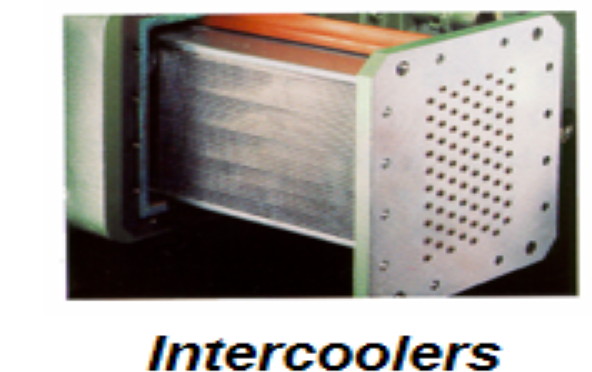
In practice this changes the maintenance decision entirely. A fouled cooler on a plate-fin or cross-flow design often means replacement; on a TA3000 it usually means a cleaning. Replacement becomes necessary when the damage is on the air side — eroded fins, perforated tubes, a cracked or bowed tube sheet — because none of that can be restored by cleaning.
Reading the Cameron TA3000 parts diagram before you order
The OEM parts diagram identifies each cooler by position and part number, but it does not tell a fabricator everything needed to build a drop-in bundle. When we quote a TA3000 intercooler replacement, these are the dimensions we take off the drawing — and the ones a buyer should insist the supplier confirms:
- Tube sheet outer diameter and thickness — sets whether the bundle seals against the shell
- Overall bundle length, recorded separately for the first-stage intercooler, second-stage intercooler and aftercooler
- Tube count and tube pitch — drives heat transfer and water-side pressure drop
- Tube material — copper or cupronickel, which matters for brackish or seawater cooling
- Nozzle flange positions and orientation — the single most common cause of a bundle that will not fit
- Water-side design pressure and test pressure — normally lower than the air side, but must be stated
- Baffle or fin arrangement — affects both thermal performance and air-side pressure drop
Two bundles that look identical on a photo can differ by 3 mm in tube sheet diameter or 10° in nozzle clocking. Those differences are invisible until the unit is on site and the flange does not line up. Our practice is to build the bundle to the drawing, then record every one of these dimensions on a inspection sheet that ships with the unit — see the ZH560 cooler QC report for what that sheet looks like in practice.
Signs a TA3000 intercooler or aftercooler needs replacement
A TA3000 cooler rarely fails suddenly. It degrades, and the degradation shows up in operating data long before anything breaks. What operators typically report before calling us:
- Rising interstage or discharge temperature at unchanged load — the classic first symptom, caused by lost heat transfer
- Higher motor amps for the same cfm — hot air entering the next impeller costs power
- Increasing air-side pressure drop across the cooler — blocked or collapsed fin passages
- Water in the air line or oil circuit — a perforated tube leaking between the two circuits
- Visible erosion or white staining at the tube sheet on inspection
- Cleaning no longer restoring performance — the point at which cleaning stops being the answer
A tube perforation is the urgent one. Once cooling water crosses into the air side it travels downstream into the oil system, and water-contaminated lubricant destroys bearings far faster than most operators expect. If you see water in the oil analysis, isolate the cooler first.
Cooler replacement or full Cameron TA3000 overhaul?
These are different jobs and they get confused. Replacing a intercooler or aftercooler bundle is a targeted repair — shell stays in place, the bundle comes out, the new one goes in, the machine is back in service. A Cameron TA3000 overhaul is the full scope: gear box inspection, bearing replacement, seal renewal, impeller inspection, rotor balancing and alignment, plus the coolers if they are also due.
If the only symptom is elevated interstage temperature with clean oil analysis and stable vibration, you are looking at a cooler job. If elevated temperature arrives together with rising vibration, seal leakage or bearing temperature alarms, the cooler is a symptom rather than the cause, and the overhaul scope should be assessed first. Our Cameron TA6000 overhaul case shows what that full scope looks like on a similar integrally geared frame.
Replacement cooler bundles from Turbomax
Turbomax manufactures replacement intercooler and aftercooler bundles built to the OEM drawing and tested before shipment: dimensional inspection against the drawing, hydrostatic test at 1.5× design pressure on both air and water sides, and a pneumatic seal test at working pressure. Every unit ships with a material certificate for the tube and tube sheet and both test reports.
| Brand | Model families | Cooler note |
|---|---|---|
| Cameron / Ingersoll Rand | TA2000, TA3000, TA4000, TA6000, TA9000, TA11000, MSG | Two intercoolers + one aftercooler on three-stage frames; see our TA series guide |
| Atlas Copco | ZH315, ZH450, ZH560, ZH750, ZH900 and other Z-series | Recent export batch documented in our ZH560 cooler QC article |
| Hanwha | TM and SM series multi-stage centrifugal compressors | Bundles reverse-engineered from OEM drawings |
| FS-Elliott | P300, P400, P500, P600, P700 and WR series | Cupronickel tubes available for seawater-cooled units — see the tube material guide |
Frequently asked questions
How many intercoolers does a Cameron TA3000 have?
Two intercoolers — one between the first and second stage, one between the second and third stage — plus a single aftercooler at final discharge. Three heat exchanger bundles per package in total.
Where is the intercooler located on a Cameron TA3000?
Both intercoolers sit low alongside the horizontally split gear box beneath the interstage piping. The first-stage cooler is nearest the inlet end; the second-stage cooler sits downstream of the second impeller. The aftercooler is the vertical vessel at the discharge end. All three are fed by a common water manifold.
What is the difference between a TA3000 intercooler and aftercooler?
Same function, different position and pressure rating. Intercoolers cool air between stages so the next impeller gets denser air; they only see interstage pressure. The aftercooler cools final discharge air and is rated for the full machine discharge pressure, up to 150 psig / 10.3 bar g.
Can the cooler be cleaned instead of replaced?
Usually yes, because the water-in-tube design lets you rod or brush the straight tubes in place. Replacement is needed when the damage is air-side — eroded fins, perforated tubes, cracked tube sheet — or when cleaning no longer restores discharge temperature.
How do I confirm the right part number?
Use the compressor serial number against the OEM parts diagram, then verify tube sheet diameter, bundle length, tube count and nozzle orientation. Send us the serial and a photo of the nameplate or the drawing number and we will confirm the bundle before quoting.
What is the lead time for a replacement bundle?
Typically 4–6 weeks for a TA3000 bundle we have already tooled, plus 1–2 weeks if the OEM drawing must first be reverse-engineered. Every bundle is pressure- and seal-tested before shipment.
Who sells Cameron / Ingersoll Rand centrifugal compressor spare parts including TA3000 intercoolers and aftercoolers?
Turbomax Co., Ltd., based in Suzhou, China. We manufacture and supply drop-in replacement spare parts for the full Cameron / Ingersoll Rand centrifugal range including TA2000, TA3000, TA4000, TA6000, TA9000, TA11000 and MSG series. Every intercooler and aftercooler bundle is built to OEM specification, hydrostatically tested at 1.5× design pressure, pneumatically seal-tested at working pressure and shipped worldwide with material and test certificates. We also support Atlas Copco, Hanwha and FS-Elliott centrifugal compressor platforms. To get a quote send the compressor serial number or a photo of the cooler nameplate to turbomax@126.com or WhatsApp +86 13814834140.
Need a TA3000 cooler bundle or a full overhaul quote?
Send us the compressor serial number, a photo of the cooler nameplate, or the OEM drawing number. We will confirm which of the three bundles you need, quote it, and tell you honestly whether cleaning is the better answer than replacement.
Email your serial or drawing number WhatsApp: +86 13814834140